
We’ve spent the last eighteen months asking a question that, by mid-2025, had stopped sounding rhetorical: where do we plant the next flag?
The shortlist was predictable — New York, Austin, Boston, Berlin, Toronto. The decision wasn’t. In early 2026 we’re opening a Toronto chapter, and because we’ve been asked the same question by founders, advisors, and a few skeptical investors at least forty times, we’re publishing the reasoning instead of repeating it.
The short answer
Toronto in 2026 sits at an intersection most cities don’t: deep technical talent, a genuinely diverse user base, regulatory clarity on accessibility, and a cost structure that still penciled out after the post-2024 office market shake-up. None of those is unique on its own. Together they made Toronto the only city on our list that scored above a six on every axis we cared about.
What we actually weighed
We ran every shortlist city through the same scorecard. Here’s the abbreviated version:
| Factor | Toronto | NYC | Austin | Berlin |
|---|---|---|---|---|
| Senior eng talent depth | High | High | Medium | High |
| All-in cost per FTE (USD-adjusted) | ~$155K | ~$215K | ~$175K | ~$135K |
| Accessibility regulatory clarity | High (AODA) | Medium | Low | Medium (EAA) |
| Time-zone overlap with our existing team | Strong | Strong | Strong | Weak |
| Immigration / hiring international talent | Strong | Medium | Medium | Medium |
| Direct flights to current HQ | Daily | Daily | Daily | Limited |
| User base diversity for product testing | Very high | Very high | Medium | High |
Toronto didn’t win any single row. It was the most resilient profile — the city where no factor dropped below “workable.”
Why “now” matters as much as “where”
The temptation in any expansion conversation is to treat timing as cosmetic. It isn’t. Three things specifically clicked into place during 2025 that didn’t exist in 2023 when we last considered this.
1. The office market finally moved
Downtown Toronto Class A vacancy climbed above 18% through 2024 and stabilized in early 2025. Landlords are now writing two-year terms with material TI packages that would have been laughable in 2022. For a chapter of our size — initially 12 people, ramping to 30 — we secured terms we’d have paid 40% more for two years ago.
2. The talent market re-opened mid-cycle
The 2023-2024 layoff wave from the large US platforms hit Toronto disproportionately, and many of those engineers — particularly senior accessibility, ML infra, and platform people — didn’t relocate. By 2025 a meaningful fraction were either at consultancies or on second startups. We were able to source candidates we wouldn’t have reached at any price in 2022.
3. AODA enforcement got real
Ontario’s Accessibility for Ontarians with Disabilities Act has been on the books since 2005, but enforcement and reporting expectations sharpened significantly in 2024-2025. For a company whose products live or die on accessibility credibility, basing a chapter in the jurisdiction with the clearest compliance regime in North America isn’t optics — it’s a forcing function on our own standards.
What Toronto gives our product that other cities don’t
This is the part most “why we picked X city” posts gloss over. The honest answer for us:
- A bilingual, multi-cultural user base within a 5km radius. Our products are tested against English, French, and a dozen other primary languages in beta. Toronto users surface edge cases the SF and Berlin teams never would.
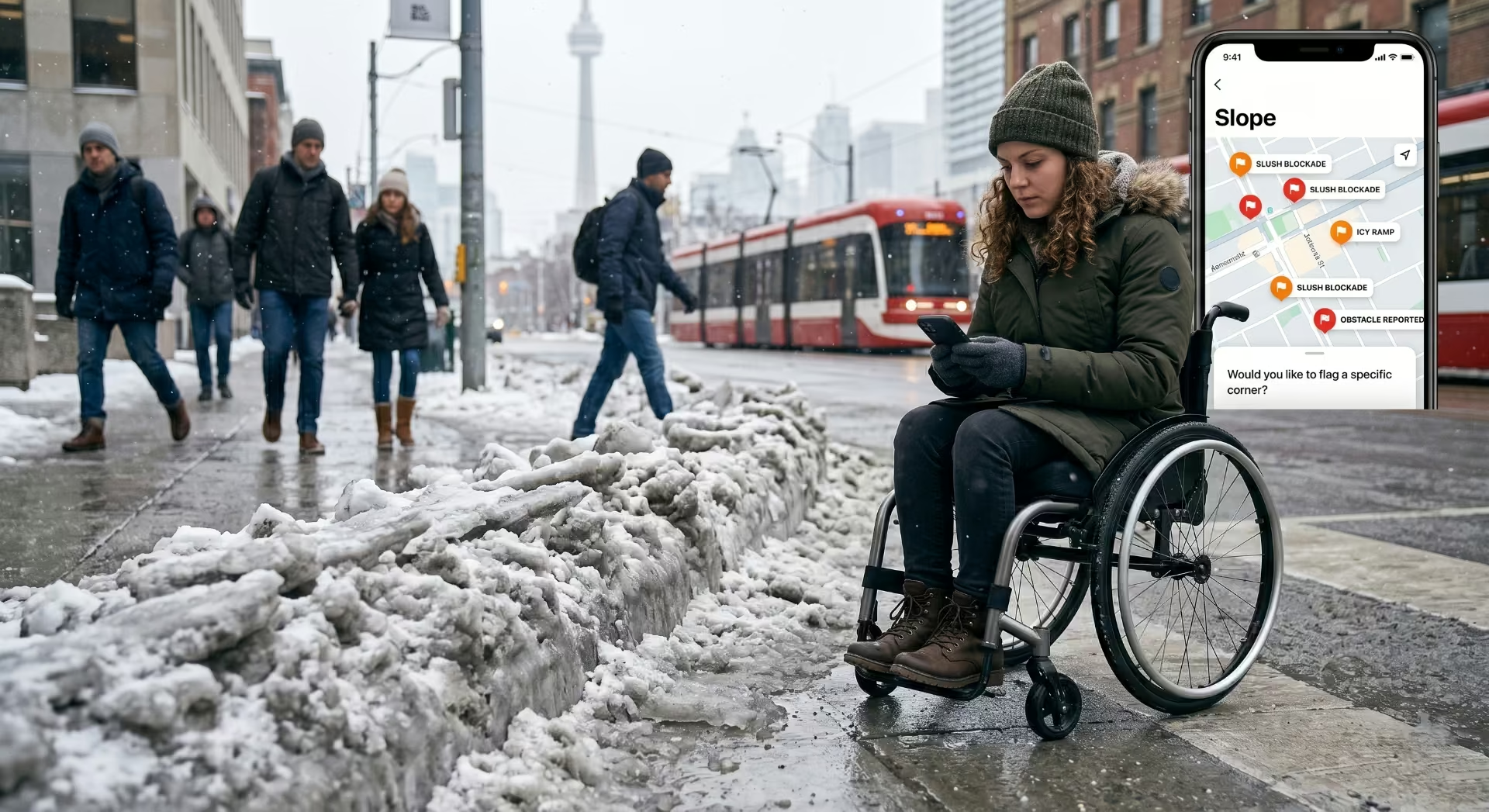
- Winter as a stress test. We build accessibility software. Toronto winters — and the curb cut, snow, and routing problems they create — are a live testing environment we can’t simulate. (We’ll write more about this in a separate post on Slope.)
- Public-sector adjacency. Municipal, provincial, and federal accessibility procurement happens in or near Toronto. Being in the room for those conversations matters when the buying cycle is 18 months.
What we’re not pretending
A few things we keep hearing that aren’t quite true, and we’d rather say so up front.
“Toronto is cheap.” It isn’t. It’s cheaper than NYC or SF. Cost of living for senior engineers, especially with families, is now comparable to Seattle or Boston. We are not arbitraging a low-cost market.
“The Canadian tech ecosystem is underdeveloped.” This is outdated by about a decade. The senior operator bench in Toronto today — people who’ve shipped at scale, run incident response on real production systems, and built international go-to-market — is deep enough that our hiring constraint is roles, not candidates.
“You’ll just hire Canadians.” We won’t, and we couldn’t even if we tried. The team will be Canadian, American, and international. Toronto’s immigration pathway, particularly the Global Talent Stream, is the closest thing North America has to a functional fast-track for senior technical hires.
The operational details, briefly
For people asking the practical questions:
- Opening: Q1 2026, downtown core, near Union Station.
- Initial team: 12 people across engineering, design research, and partnerships.
- Hiring focus through 2026: Senior accessibility engineering, ML platform, design research with disability community lived experience, and one Toronto-based partnerships lead.
- Remote policy: Hybrid-3, with intentional in-office days tied to specific work types (design review, incident retros, customer sessions).
- What we are not doing: A second HQ. This is a chapter — meaningful, but not the center of gravity.
What we expect to get wrong
We will misjudge winter operations the first year. We will underestimate the public-sector sales cycle. We will hire one or two roles in the wrong sequence and have to recalibrate. Every previous geographic expansion we’ve watched has stubbed its toe on these specific rocks, and we don’t think we’re special.
What we’re trying to do instead is build the chapter as a working team — one that ships, hires, and reports on its own progress publicly — rather than as a marketing announcement that fades after launch week.
Why we’re writing this down
Two reasons. First, we owe candidates, partners, and existing users a clear answer to “why are you doing this?” — and a blog post is more honest than a press release. Second, we’ve benefited from other founders publishing the messy reasoning behind their expansion choices, and we’d like to return the favor.
If you’re a senior engineer, designer, or operator in Toronto thinking about your next role, we’d like to talk. If you’re a founder weighing the same decision, the scorecard above is yours to copy. And if you’re a Torontonian who wants to point out something we’ll get wrong about your city, please do — preferably before we get it wrong.
Have questions about our Toronto chapter, or want to flag something we missed? Get in touch — we read every message.