
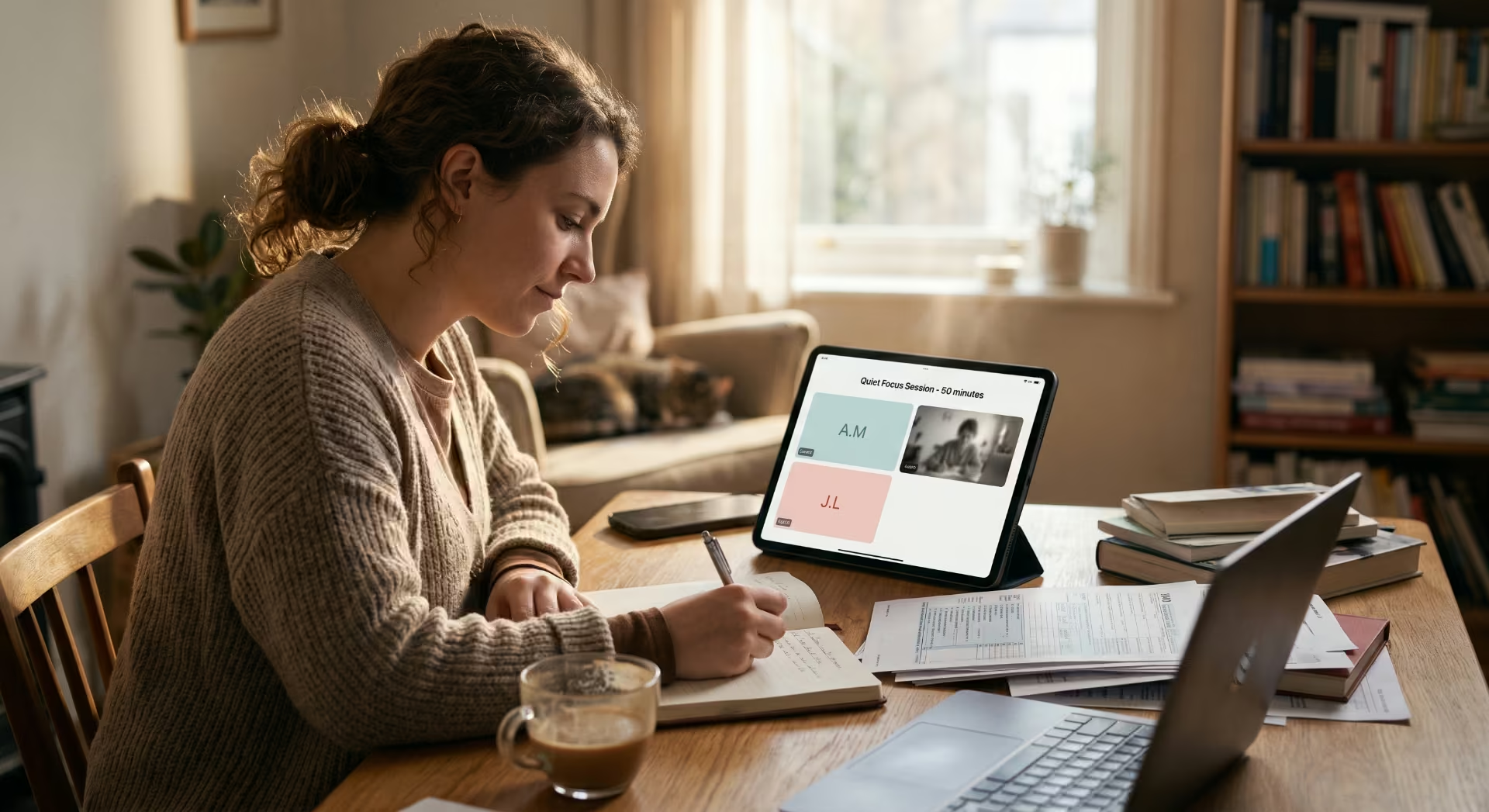
A year ago we launched a body-doubling feature inside our app, expecting it to be a modest companion to the timers and task lists we already shipped. Twelve months and roughly 14,000 sessions later, the body-doubling feature has more daily active users than any other thing we make, and we’ve had to rewrite most of what we thought we knew about ADHD productivity.
This post is the honest write-up. What body-doubling is, what worked, what didn’t, what the data actually says, and where we got the framing wrong.
What body-doubling is, for the people who haven’t met it
Body-doubling is the practice of doing a task in the presence of another person — not to be helped, not to be supervised, just to be witnessed. The other person works on their own thing. You work on yours. The presence is the point.
For many ADHD adults, this is the closest thing to a reliable on-switch for tasks that the executive function won’t otherwise start: tax forms, laundry, the email you’ve been avoiding for nine days, the apartment cleaning that’s somehow grown into a fourteen-hour project in your head.
The mechanism is contested. The leading hypotheses involve some combination of social accountability, externalized structure, dopamine regulation through low-stakes social engagement, and the simple fact that another person sitting nearby makes the task feel less like a void. We don’t pretend to know which of these is doing the work. What we can tell you is what showed up in the data.
The setup
In late 2024 we launched paired and small-group video body-doubling sessions inside our app. Users could:
- Drop into a 25- or 50-minute open session with strangers
- Schedule a 1:1 with a recurring partner
- Join a topic-specific group (admin tasks, creative work, household, study)
Cameras optional. Mics off by default. A 60-second intro where each person says what they’re working on, then silence, then a 60-second close where each person says what they got done — or didn’t.
We did not try to optimize the sessions. We didn’t gamify them. We instrumented them carefully and listened.
The numbers
After 12 months, here’s what we can say with reasonable confidence:
| Metric | Result |
|---|---|
| Total sessions completed | ~14,000 |
| Median sessions per active user, per week | 3.2 |
| Self-reported task completion rate during sessions | 78% |
| Self-reported task completion rate outside sessions (control) | 41% |
| 30-day retention for users who completed 3+ sessions in week one | 67% |
| 30-day retention for users who completed 1 session in week one | 19% |
| Users who said they’d recommend it (NPS-equivalent) | +71 |
The headline number — 78% versus 41% task completion — is self-reported and we treat it as directional, not gospel. But the gap is too wide and too persistent across user cohorts to be an artifact. Something is happening in those sessions.
The retention numbers are the more interesting story. Three sessions in week one isn’t a magic number; it’s the threshold where users seem to have figured out which session format works for them. Below that, the feature reads as a curiosity. Above that, it becomes a habit.
What worked
Five things, in roughly the order of how surprised we were by them.
1. Silence
We assumed sessions would feel awkward without some structured interaction. They didn’t. After the 60-second intro, the silence is the feature. Multiple users told us the silence is the closest thing they get all week to focused work without the cost of solitary willpower.
2. Strangers, not friends
We expected paired sessions with friends to be the most popular format. They weren’t. Open sessions with strangers had higher completion rates and better retention. The hypothesis from user interviews: with strangers, there’s just enough social pressure to stay on task and zero social pressure to perform or chat.
3. The 60-second close
The “what did you get done” check-out at the end was the single most-mentioned element in our user research. Not because users wanted to brag, but because saying out loud what you did — even to a stranger — converted the session from “an hour I was online” into “an hour I worked.” Several users described it as the moment their brain finally accepted that the task had been done.
4. Camera-optional, not camera-required
We launched with cameras default-on. Adoption was tepid. We switched to default-off and adoption jumped roughly 3x in two weeks. For a population that often has co-occurring anxiety, RSD, or just doesn’t want to be on video before they’ve showered, removing the camera friction wasn’t a minor UI tweak. It was the difference between using the feature and not.
5. Predictable rhythm
Sessions that started at the same time every day, with the same length, attracted the most consistent users. The predictability was the value. ADHD adults are not — contrary to one persistent stereotype — opposed to routine. They are opposed to routines they can’t sustain. A session that runs at 9am every weekday, that you can join with one tap, lowers the activation energy past the point where it competes with the executive function.
What didn’t work
We tried a lot of things that we thought would work and didn’t.
Gamification. We A/B tested streaks, points, badges, and weekly leaderboards. All four hurt retention. Streaks were the worst — users who missed a day stopped using the feature entirely rather than restart. The shame of a broken streak was a bigger force than the satisfaction of an intact one. We pulled all of it within four months.
AI session coaches. We tested an AI prompt at the start of sessions that asked users to break down their task into sub-steps. Adoption was low and users reported feeling judged by it. Hypothesis: the value of body-doubling is being witnessed by a person, not coached by a system. An AI does not satisfy the underlying need.
Longer sessions. We assumed deep work demanded 90-minute blocks. Wrong. The 25- and 50-minute formats outperformed 90 minutes by every metric. Users were more likely to start, more likely to finish, and more likely to come back.
Topic groups for “productivity.” Topic-specific groups worked for admin, creative, household, and study. A generic “productivity” group performed worse than any of them. The specificity was the value — knowing you’re in the room with other people doing taxes, specifically, made the taxes more doable.
What we got wrong about productivity
The biggest lesson from the year is not about features. It’s about framing.
We launched the feature inside a productivity app and described it as a productivity tool. Both of those were defensible. Both of them, in retrospect, are slightly wrong.
For most of the users who got real value from body-doubling, the win is not measured in tasks completed. It’s measured in the absence of a particular kind of suffering. The hours of avoidance before starting. The shame spiral after another missed deadline. The exhausting interior negotiation that ADHD adults run constantly to get themselves to do things that other people seem to do without thinking.
Body-doubling, when it works, doesn’t make you more productive. It makes the cost of being productive lower. Those are different claims.
The mainstream productivity vocabulary — output, optimization, throughput — fits poorly on what’s actually happening. A better vocabulary, borrowed from users in our interviews, treats productivity as the byproduct of two things: lowering the activation cost of starting, and reducing the cognitive overhead of staying. Body-doubling does both. Most other “productivity” tools do neither, and a few of them — looking at you, gamified habit trackers — actively raise the cost.
What we’re changing
Based on the year, here’s where the product goes:
- Body-doubling moves from a feature to the center of the app. It’s not a sidebar to timers and lists. It’s the primary surface.
- We drop the productivity framing. The next version describes itself in terms of starting, not finishing. “Help me start” is the dominant verb our users use. We should match that.
- We invest in predictable rhythms. Default daily sessions at consistent times, joinable in one tap.
- We continue to refuse to gamify it. Streaks, points, and leaderboards remain off the roadmap.
- We add more topic-specific rooms, not generic ones.
What we’re still figuring out
A few things we don’t have good answers to yet:
- How body-doubling scales for users who work primarily in physical spaces (cleaning, errands, in-person caretaking). Video isn’t the right shape for that. Audio-only might be. We’re testing.
- Whether the value generalizes to non-ADHD users. Our user base is heavily ADHD-identified, but the early signal suggests body-doubling has appeal for autistic adults, people with depression, and a broader set of users who struggle with task initiation for any reason. We don’t yet know if the same features serve those audiences equally well.
- The long arc. Twelve months is enough to see a habit form. It isn’t enough to know whether the habit displaces or supplements other strategies — therapy, medication, structural changes at work. We’re following a cohort into year two to find out.
The thing we keep coming back to
The productivity industry has spent two decades selling the idea that productivity is a personal optimization problem. For ADHD adults, this framing is not just unhelpful — it’s actively harmful. It locates the failure inside the individual and offers tools that demand more of the executive function the person already doesn’t have enough of.
Body-doubling locates the solution somewhere else: in the simple fact of another person sitting nearby, working on their own thing. It doesn’t ask the user to be more disciplined. It changes the environment so that less discipline is required.
If there’s a single thing we learned in the last year, it’s that. The most useful productivity tool for ADHD brains might be the one that demands the least productivity-tool behavior from its user.
If you’ve body-doubled and have a story or a critique, we want to hear it. Get in touch. And if you’re a researcher working on adjacent questions, please reach out — we’d love to share what we have.